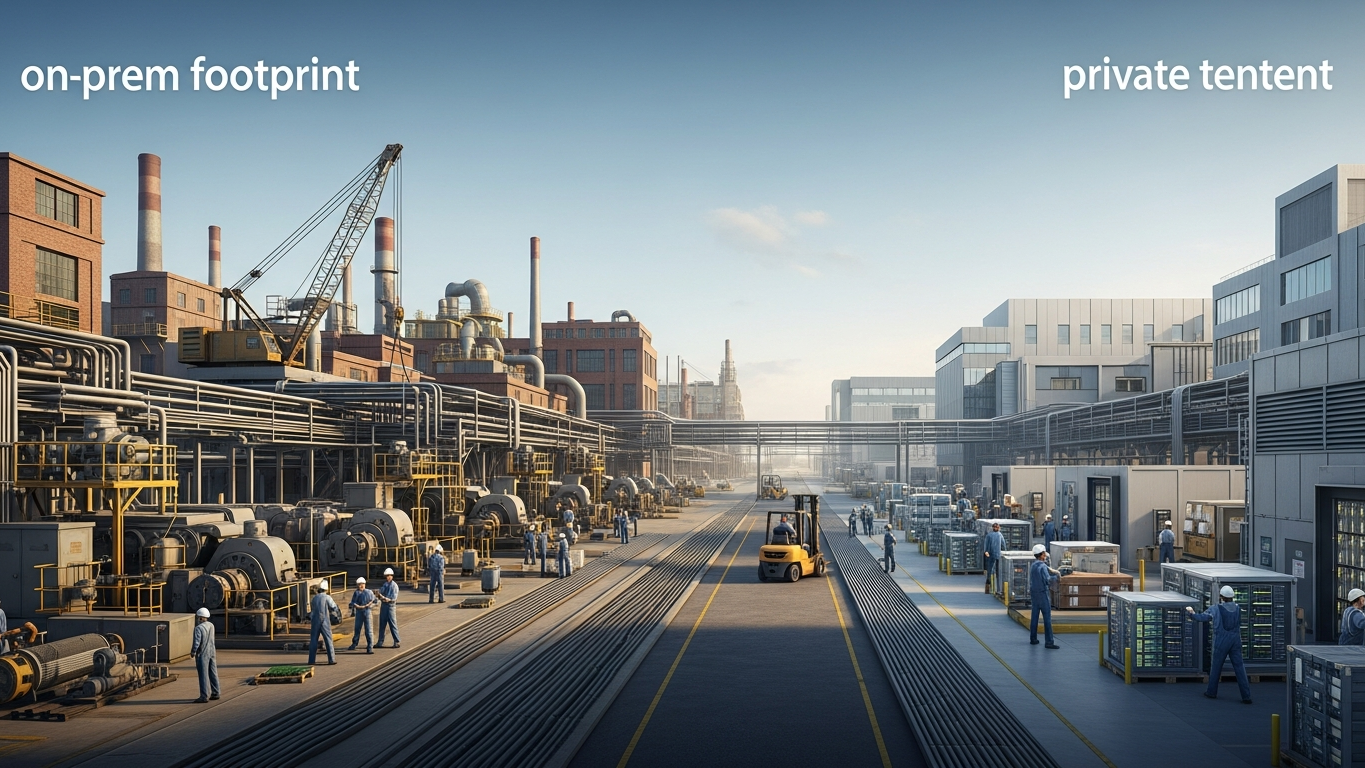
Core problem: on-prem AI is often chosen for symbolic control or avoided for convenience, without a disciplined trade-off model tied to real constraints
Main promise: manufacturers can decide when on-premise industrial AI is worth operational burden using data sensitivity, regulatory posture, integration depth, latency needs, and internal capability
On-prem AI is not automatically virtuous. Cloud AI is not automatically modern. The right answer is constraint-driven—because the goal is not to win an architecture debate. The goal is to match compute and custody to the risk model your plant already lives under.
On-prem AI is usually worth the complexity when strict data sovereignty, air-gap or near-air-gap requirements, deep OT adjacency, or contractual audit constraints dominate the decision. It is often not worth it when workloads are exploratory, non-sensitive, and better served by fast elastic capacity under a strong private-tenant contract with clear training and egress controls. The mistake is choosing a label to signal seriousness—or rejecting on-prem without measuring what your constraints actually require.
Why symbolic choices fail
Some teams choose on-prem to signal seriousness without staffing it. Some teams reject on-prem because it feels old without measuring risk. Both patterns create regret: either you own a stack you cannot operate safely, or you accept cloud patterns your policy story cannot defend. The fix is a trade-off model that names the real drivers: classification, contracts, network reality, resilience, skills, and total cost horizon.
Decision factors that should drive the answer
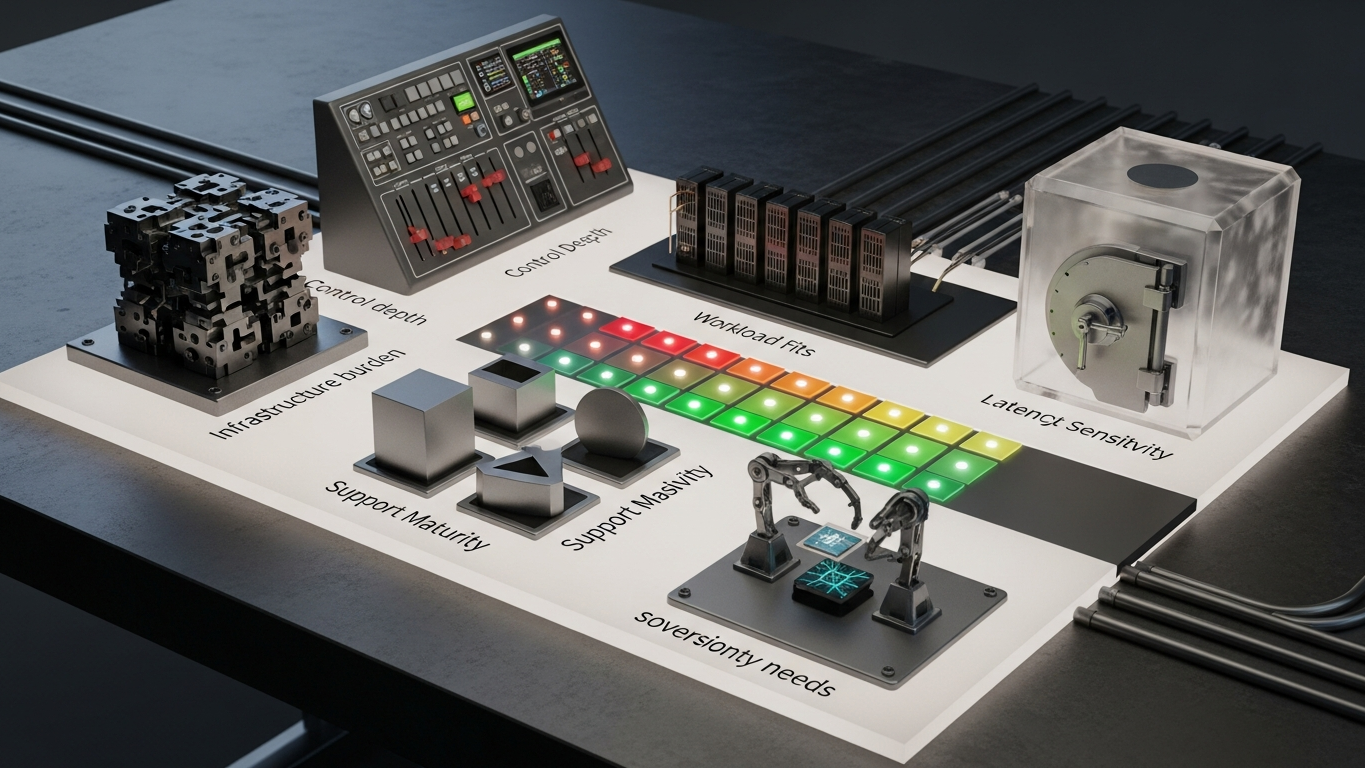
Data sensitivity and classification matter first. If security classifies inputs as restricted, on-prem or highly isolated cloud becomes plausible. Regulatory and customer contractual clauses can force location control and limit cross-border flows. OT proximity and segmentation can push runtime placement when AI must sit close to line systems with tight boundaries. Performance and availability models differ: on-prem needs your own resilience story; cloud can simplify elasticity if boundaries are acceptable. Operational maturity matters—on-prem requires patching, monitoring, backup, and incident response ownership. Total cost horizon should include hardware lifecycle, staffing, and vendor support across years, not only license price.
When on-prem is likely worth it
Strong cases often include highly regulated manufacturing contexts, customer contracts prohibiting certain cloud paths, strategic refusal to let prompts leave a controlled enclave, and integration patterns that would multiply egress risk in multitenant designs. These are not ideological positions. They are responses to constraints that already exist in the business.
When on-prem is often not worth it
Weaker cases often include early experimentation with no sensitive data, teams without capacity to run secure ML infrastructure, and workloads that only need a well-isolated private SaaS tenant with strong contractual controls. Sometimes a private tenant wins on speed while still meeting governance—if the boundary story is real, not cosmetic.
Evaluate both on-prem and private cloud tenant options against training policy defaults, egress controls, logging export, change velocity, and disaster recovery. Hybrid can be honest when it is explicit: highest-sensitivity workflows on the tightest runtime, lower classes on a governed tenant, unified under one governance model.
On-prem, isolated tenant, and private API paths differ in operating cost and internal skill; they should win or lose on the factors in your checklist, not on label pride. Vector supports that honest comparison: proprietary industrial AI with on-premise, private API, and isolated deployment paths, client data excluded from model training, so the mode you pick tracks regulatory and network reality instead of default aesthetics.
On-prem is a serious operations commitment. Choose it when constraints demand it, not when marketing aesthetics do. When a controlled cloud tenant meets the same boundaries with less drag, that can be the more rational industrial choice.
Plant checkpoint
Treat “When On-Prem AI Is Worth the Complexity and When It Is Not” as a decision tool, not background reading. Before the next steering meeting, ask for one artifact that proves your posture—an architecture diagram, a training-policy excerpt, a log sample, a signed workflow classification, or a promotion record. If the room can only tell stories, you are still in pilot clothing. Manufacturing AI matures when evidence becomes routine: the same discipline you already expect before a line release, a supplier change, or a major IT cutover. That is the shift from excitement to infrastructure—and it is what keeps programs coherent across audits, turnover, and multi-site expansion.
If leadership wants one crisp decision habit, make it this: name what must be true before usage expands, then review whether it is true on a fixed cadence. That is how governance stops being a narrative comfort and becomes an operating metric your plants can execute.
DBR77 Vector supports on-premise, private API, and isolated deployments so manufacturing teams can match mode to real constraints rather than defaulting to public convenience. Explore products using Vector or Book a demo.