
Core problem: many AI vendors claim industrial relevance without explaining what kind of real-world experience actually shaped the model
Main promise: manufacturers should care about whether an AI system learned from real transformation logic rather than generic internet-style patterns
Many AI products claim industrial intelligence. Very few explain what that actually means in a way a plant leader can verify. If a vendor says the model is shaped by real transformation cases, the buyer should ask what kind of experience sits behind that claim—because “industrial” is easy to say and hard to earn.
AI quality is not only about architecture. It is also about what kind of patterns the system has been shaped around. In manufacturing, useful AI should reflect exposure to transformation decisions, operational bottlenecks, implementation trade-offs, and improvement logic. Without that shaping, the model may still sound capable while lacking practical depth—the kind of depth that shows up when the question is messy, the data is incomplete, and the answer still has to be safe enough to discuss in a morning meeting.

Real transformation cases create different reasoning
An AI influenced by real industrial transformation work should be better at recognizing what matters in a plant context, where risk hides, how execution complexity changes decisions, and why recommendations still need governance. That is different from generic internet-pattern fluency, which can produce confident language about “lean” and “digital” without grounding the narrative in the constraints of a real line, a real quality system, and a real capital calendar.
This is not the same as saying “we know manufacturing”
Many vendors use broad industrial language. That is not enough. Manufacturers should ask what kind of transformation situations informed the model, how that shows up in reasoning quality, and whether the system reflects implementation reality or only surface terminology. These questions help separate marketing familiarity from operational depth—the difference between a tool that sounds like your industry and a tool that behaves responsibly inside it.
Why this matters in buying decisions
If an AI system has no meaningful exposure to real transformation logic, the buyer may get shallow suggestions, weak prioritization, low consequence awareness, and limited operational usefulness. That usually becomes visible only after the pilot stage—when the demo prompts are gone and the work is no longer curated.
Domain training should still be governed
Real-case learning does not remove the need for governance. It should make the model more useful, not more autonomous by default. Manufacturers still need clear deployment boundaries, no training on client data, traceability, and human approval where stakes require it. Depth and control are partners, not substitutes.
DBR77 Vector is positioned as industrial AI informed by real factory transformation knowledge: industrial reasoning, stronger governance expectations, private deployment options, and no training on client data. That makes the claim more about operating relevance than generic AI ambition.
Training an AI on real transformation cases should mean the system reflects practical industrial logic, not only industry vocabulary. For manufacturers, that difference can shape whether the model becomes genuinely useful or merely impressive in a demo.
Plant checkpoint
Treat “What It Means to Train an AI on Real Transformation Cases” as a decision tool, not background reading. Before the next steering meeting, ask for one artifact that proves your posture—an architecture diagram, a training-policy excerpt, a log sample, a signed workflow classification, or a promotion record. If the room can only tell stories, you are still in pilot clothing. Manufacturing AI matures when evidence becomes routine: the same discipline you already expect before a line release, a supplier change, or a major IT cutover. That is the shift from excitement to infrastructure—and it is what keeps programs coherent across audits, turnover, and multi-site expansion.
If leadership wants one crisp decision habit, make it this: name what must be true before usage expands, then review whether it is true on a fixed cadence. That is how governance stops being a narrative comfort and becomes an operating metric your plants can execute.
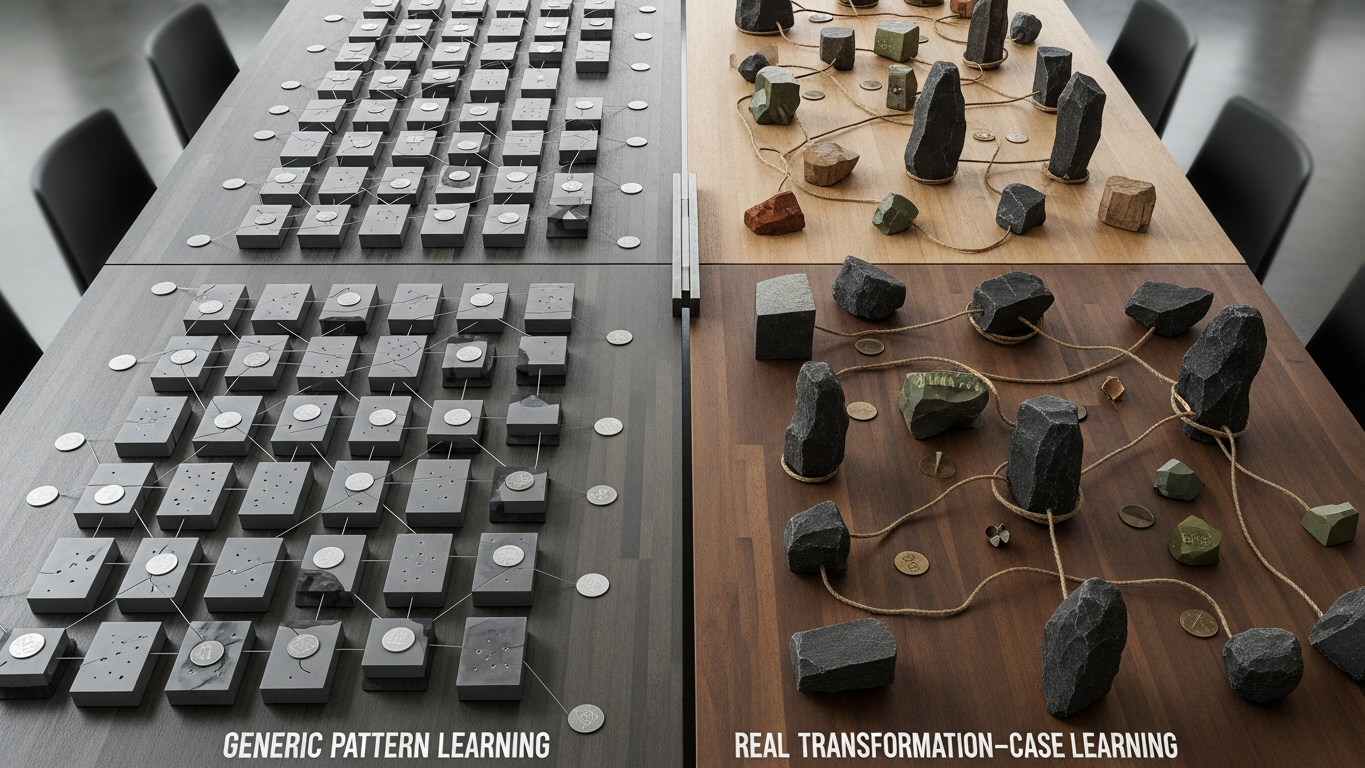
DBR77 Vector is positioned around industrial reasoning shaped by real factory transformation knowledge, not only generic AI patterns. Explore products using Vector or Review security.