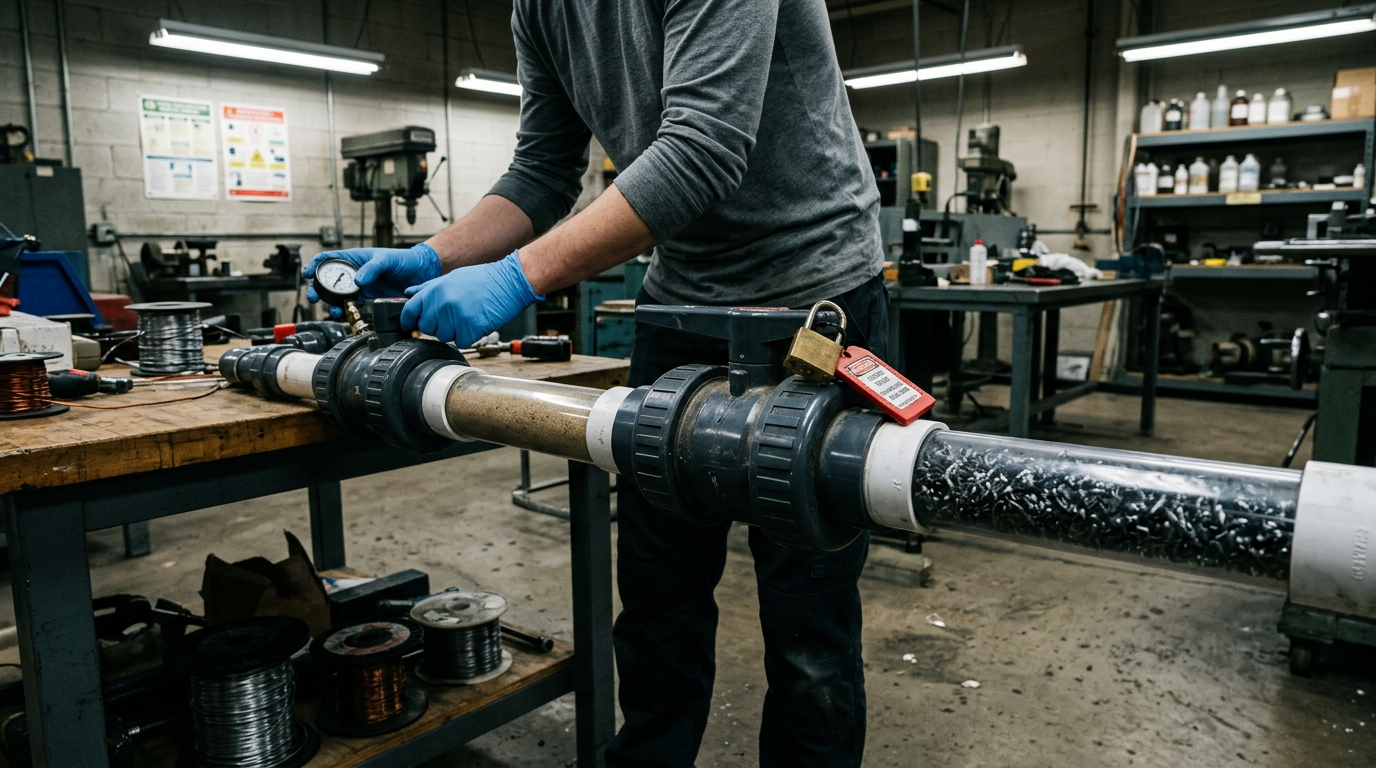
Core problem: AI systems change weekly through prompts, connectors, and model routes while factories expect the same rigor as MES or PLC changes
Main promise: a tight change model keeps innovation speed inside visible gates without treating every tweak like a waterfall release
Change control is not hostility to iteration. It is how iteration stays insured, auditable, and reversible—because manufacturing already knows what uncontrolled change costs: surprise behavior, disputed records, and investigations that cannot reconstruct what moved.
A secure AI change control process for manufacturing should include a classified change taxonomy, mandatory impact assessment per class, peer or CAB review for production-impacting changes, versioned promotion paths from sandbox to production, automated regression checks where possible, dual approval for privileged configuration, immutable logs tied to tickets, rollback artifacts for each release, and post-change verification signed by workflow owners. Client data must never enter training paths as part of a change unless explicitly governed by a separate legal and technical program. Treat model routes like network routes: invisible changes are still changes.

Why plants notice change—even when the UI looks the same
Manufacturing teams experience AI changes as behavior changes: a summary suddenly emphasizes different risks, a recommendation pattern shifts after a weekend deployment, an integration starts timing out under peak load. Without a ticket trail, those shifts feel like “the model got weird,” which is how trust dies. With a ticket trail, the same shifts become explainable events: what changed, who approved it, what was observed afterward, and how rollback works if the line impact is real. That is the cultural payoff of change control—not paperwork for its own sake, but predictable operations.
Five change classes that keep velocity sane
Documentation and help text sit in the lowest class when no behavior changes—yet even here a log entry matters because teams will later ask what was true at a point in time. Prompt and template edits inside approved bounds should produce an automated diff, a reviewer from product or engineering, and a time-bound observation window so operations can report regressions early. Connector or scope expansion should trigger architecture alignment, a data path update, and security sign-off—because you changed what the system can reach, not only what it says. Model version or routing changes should include performance and safety checks plus stakeholder communication to affected plants, especially when outputs influence planning or quality narratives. Emergency break-glass should be time-boxed, with mandatory post-incident review so urgency does not become a permanent bypass culture.
Minimum ticket content includes a plain-language change summary, affected workflows and sites, risk class and rollback plan, test evidence or rationale if tests are not automatable, and approvers with timestamps.
Ad hoc tweaks feel fast in week one; gated promotion feels slower—and produces reconstructable history in year two. Prompt, connector, and model-route edits are factory changes; tickets need the same who-when-rollback discipline as other plant-adjacent systems.
Bottom line: if your AI stack can change behavior without changing records, you will eventually argue about causality instead of fixing the line.
Vector fits environments where promotion is serious: deployment boundaries that separate sandboxes from production paths, client data not used to train the model, proprietary industrial reasoning trained on factory transformation knowledge instead of generic chat—so change control has stable objects to attach approvals and evidence to.
If you cannot answer what changed, when, and why, you do not have enterprise AI. You have a live experiment wearing a production badge.
Plant checkpoint
Treat “What a Secure AI Change Control Process Should Include” as a decision tool, not background reading. Before the next steering meeting, ask for one artifact that proves your posture—an architecture diagram, a training-policy excerpt, a log sample, a signed workflow classification, or a promotion record. If the room can only tell stories, you are still in pilot clothing. Manufacturing AI matures when evidence becomes routine: the same discipline you already expect before a line release, a supplier change, or a major IT cutover. That is the shift from excitement to infrastructure—and it is what keeps programs coherent across audits, turnover, and multi-site expansion.
If leadership wants one crisp decision habit, make it this: name what must be true before usage expands, then review whether it is true on a fixed cadence. That is how governance stops being a narrative comfort and becomes an operating metric your plants can execute.

DBR77 Vector fits programs that need environment separation and promotion discipline rather than unmanaged prompt churn in production. Book a demo or Review security.