
Core problem: training policy language is often vague, which lets vendors hide default-on data use behind friendly privacy pages
Main promise: buyers can compare training policies using a fixed vocabulary that separates defaults, scope, retention, subprocessors, and technical enforcement
Training policy is where marketing fog is thickest. It is also where real exposure often lives—because “private” and “secure” do not automatically answer the question your security team will ask first: can our operational language become fuel for someone else’s model improvement loop?
Compare policies by asking five concrete questions: what is the default for client data in model improvement, what exact data classes are in scope, how long data persists in vendor systems, which subprocessors can touch it, and what technical controls enforce the written policy. If any answer is hand-wavy, treat it as unresolved risk—not as a detail to smooth over in the pilot plan.
Why “we do not sell your data” is not enough
That sentence addresses a different fear. Training and improvement loops are a separate mechanism. A vendor can claim strong privacy while still using prompts for quality tuning unless the contract and architecture say otherwise. Industrial buyers need both: language that matches behavior, and behavior that matches the plant’s data class.
Comparison framework: five policy layers
Default posture: is client content included in improvement by default? You want clarity on opt-in versus opt-out versus always-off. Always-off with technical enforcement is the strongest industrial posture when sensitive payloads are involved.
Scope of data classes: separate user prompts, uploaded documents, system outputs, feedback signals such as thumbs-up metadata, and telemetry. Manufacturing buyers should know which classes can touch model improvement—even when training is “off,” retention may still create exposure.
Retention windows: even if training is off, retention can still create risk. Ask how long inputs are stored, whether storage is segmented, and how deletion requests propagate.
Subprocessors and geography: map who can process data and where. Industrial buyers often need region constraints, named subprocessors, and change-notification rules that match enterprise standards.
Technical enforcement versus policy promises: request how defaults are enforced—configuration posture, contractual commitments, audit rights, and testing expectations. Policy without enforcement is marketing in a suit.
A simple scoring rubric
Score each layer: explicit and favorable to the buyer with a technically plausible story; partially clear or conditional; vague, silent, or default-on risk. Repeated low scores are a signal: the platform may be fine for disposable tasks and wrong for sensitive manufacturing workloads.
Red-flag phrases translated
“We may use data to improve services” often signals broad improvement rights. “Aggregated and de-identified” still needs process detail in AI contexts. “Enterprise controls available” may mean paid add-ons, not baseline posture—ask what the baseline is for your contract tier.
How pilots should test policy, not only accuracy
A serious pilot includes a written training posture for the pilot tenant, log review expectations, and scenarios that validate handling boundaries—not only model quality. Accuracy demos without policy proof are incomplete, because the first production incident is often a boundary incident, not a math error.
Training policy comparisons only bite when the same statements show up in contracts, architecture narratives, and logs you can sample on a pilot. Vector matches that bar as a baseline claim to verify like any other: client data does not train the model, alongside on-premise, private API, or isolated deployment options and proprietary industrial reasoning trained on factory transformation knowledge instead of repurposed consumer chat behavior.
Training policy comparisons are not legal trivia. They define whether your operational knowledge becomes someone else’s improvement fuel. Use a fixed framework so vendors cannot fog the conversation.
Plant checkpoint
Treat “How to Compare Industrial AI Training Policies Without Marketing Fog” as a decision tool, not background reading. Before the next steering meeting, ask for one artifact that proves your posture—an architecture diagram, a training-policy excerpt, a log sample, a signed workflow classification, or a promotion record. If the room can only tell stories, you are still in pilot clothing. Manufacturing AI matures when evidence becomes routine: the same discipline you already expect before a line release, a supplier change, or a major IT cutover. That is the shift from excitement to infrastructure—and it is what keeps programs coherent across audits, turnover, and multi-site expansion.
If leadership wants one crisp decision habit, make it this: name what must be true before usage expands, then review whether it is true on a fixed cadence. That is how governance stops being a narrative comfort and becomes an operating metric your plants can execute.
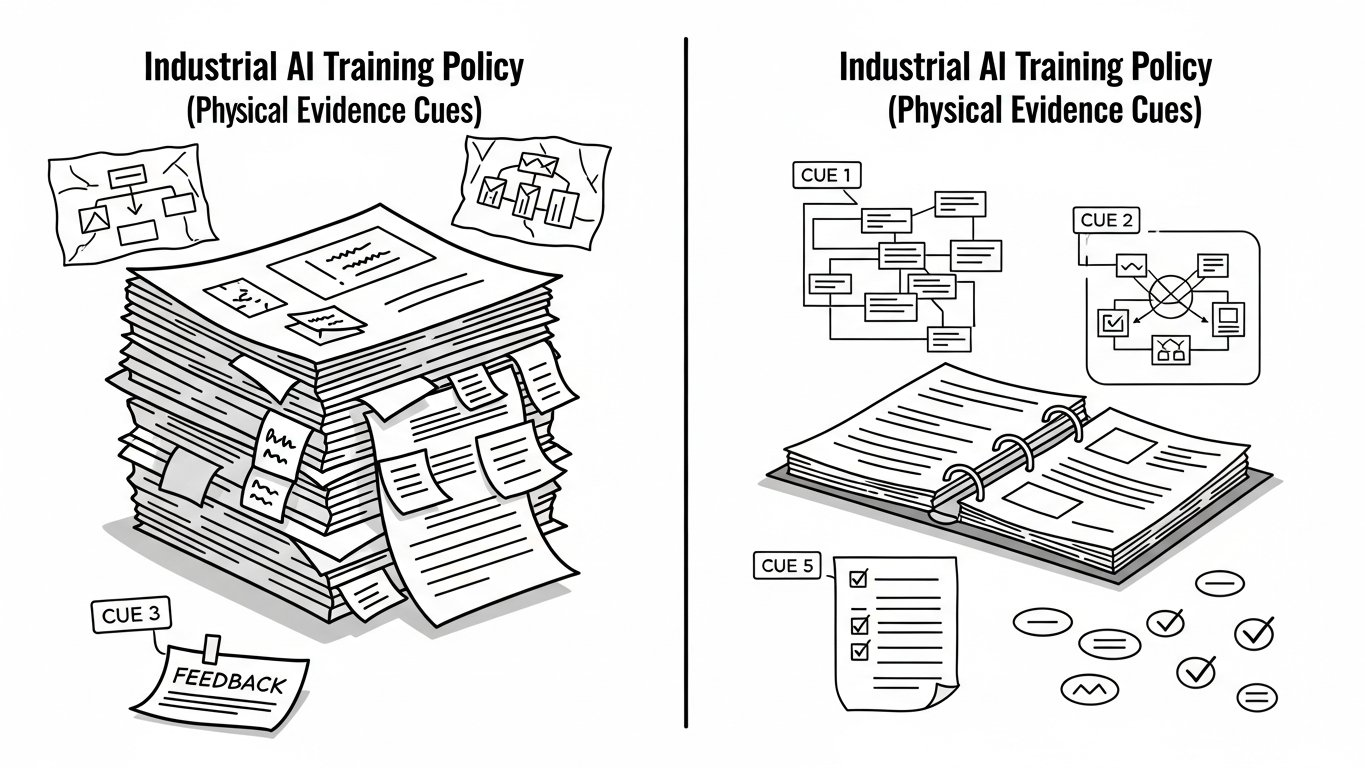
DBR77 Vector states a clear industrial training posture with client data excluded from model training, aligned to private deployment options. Review security or Book a demo.