Core problem: pilots often start as unofficial tool trials that bypass security and integration rules, which later collapse under scale or audit pressure
Main promise: manufacturers can run a fast pilot that still has an explicit charter, data class, deployment boundary, logging plan, and exit criteria so it stays legitimate
A governed pilot is still a pilot. It is not a bureaucracy dressed as innovation. It is a time-boxed experiment with explicit boundaries—so speed does not turn into shadow IT that your security team discovers months later, or into “production” workflows running on informal accounts and unclear retention.
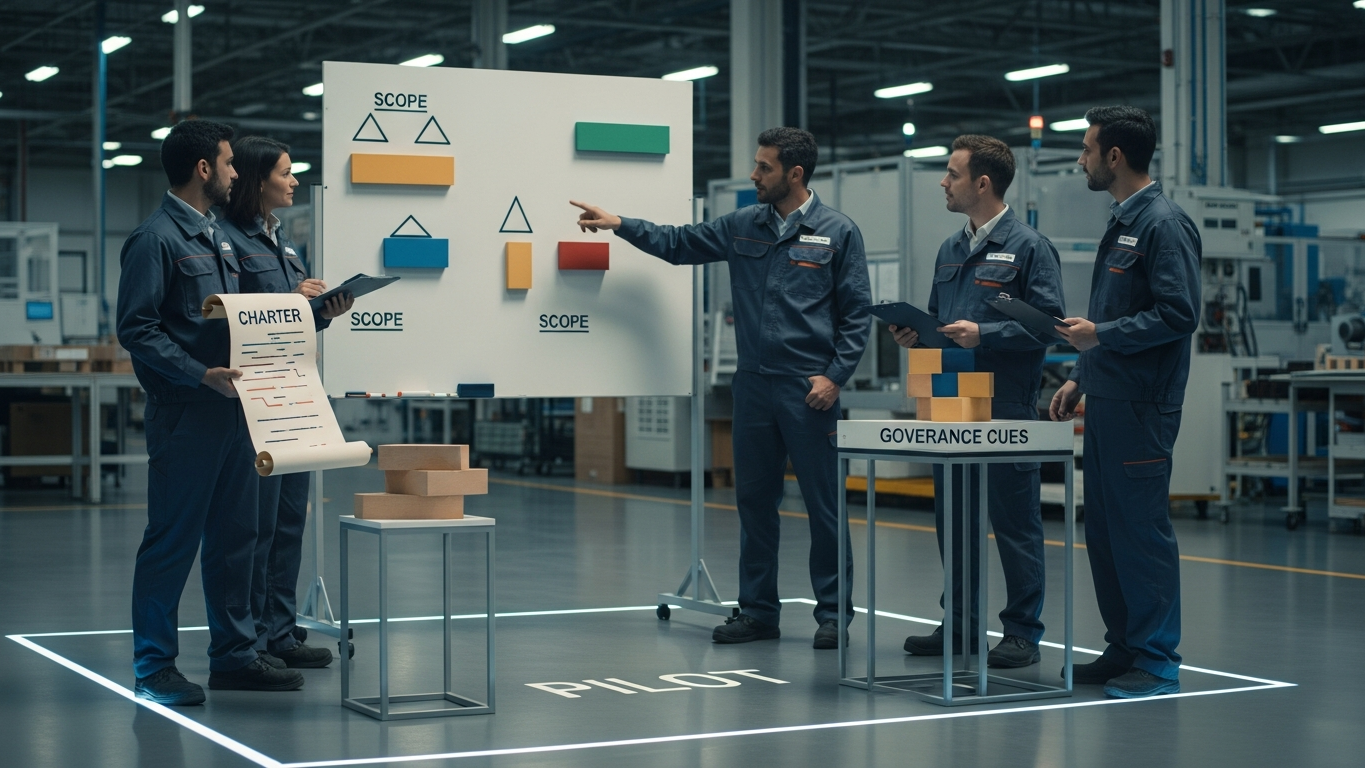
Build the pilot as a signed mini-charter: named sponsor, allowed data classes, fixed deployment boundary, integration scope, logging and retention rules, success metrics, stop conditions, and a path to production governance. If those elements are missing, you are building shadow IT with better storytelling—and shadow IT always reconciles eventually, usually expensively.

Why shadow IT happens around AI
AI pilots tempt teams because they feel low commitment. Credit cards, free tiers, and personal accounts make bypass easy. Manufacturing consequences are still real: the same payloads that would trigger review in an ERP integration can move through a browser without anyone noticing—until someone asks for evidence.
A practical sequence that keeps legitimacy
Name an executive sponsor so accountability has teeth. Define the decision the pilot supports; avoid “we are testing AI” as a charter. Classify data explicitly: what is allowed, forbidden, and synthetic-only. Choose the deployment boundary before the model, matching boundary to classification. Freeze integration scope—if no MES writebacks are allowed yet, write that down so nobody “helpfully” extends it. Set logging and review cadence; weekly log review beats post-incident panic. Define measurable outcomes with a small set of KPIs that matter to operations, not only to innovation theater. Publish stop conditions: if security findings emerge or accuracy stalls, the pilot pauses. Plan the production gate: what must be true to expand, including procurement and security sign-off.
Governed versus shadow: governed pilots have a charter in writing, IT and security awareness, controlled identities, and defined data paths. Shadow pilots have informal accounts, unclear retention, unmapped egress, and surprise integrations.
Procurement can help without slowing forever through a pre-approved pilot envelope: capped spend, fixed duration, named vendor and deployment mode, and required security artifacts. Speed and discipline can coexist when the envelope is real.
A pilot charter collapses into shadow IT when the tool cannot be written into approved identity, data, and procurement envelopes from week one. Vector is meant for governed programs: explicit deployment boundaries, proprietary industrial reasoning trained on factory transformation knowledge, and no client-data training of the shared model—so the charter you publish has a platform class that fits formal gates instead of informal workarounds.
The fastest pilot is not the one with the fewest rules. It is the one that will survive the first security review and the first scale conversation. Governance early is cheaper than reconstruction later.
Plant checkpoint
Treat “How to Build a Governed Pilot for Industrial AI Without Creating Shadow IT” as a decision tool, not background reading. Before the next steering meeting, ask for one artifact that proves your posture—an architecture diagram, a training-policy excerpt, a log sample, a signed workflow classification, or a promotion record. If the room can only tell stories, you are still in pilot clothing. Manufacturing AI matures when evidence becomes routine: the same discipline you already expect before a line release, a supplier change, or a major IT cutover. That is the shift from excitement to infrastructure—and it is what keeps programs coherent across audits, turnover, and multi-site expansion.
If leadership wants one crisp decision habit, make it this: name what must be true before usage expands, then review whether it is true on a fixed cadence. That is how governance stops being a narrative comfort and becomes an operating metric your plants can execute.
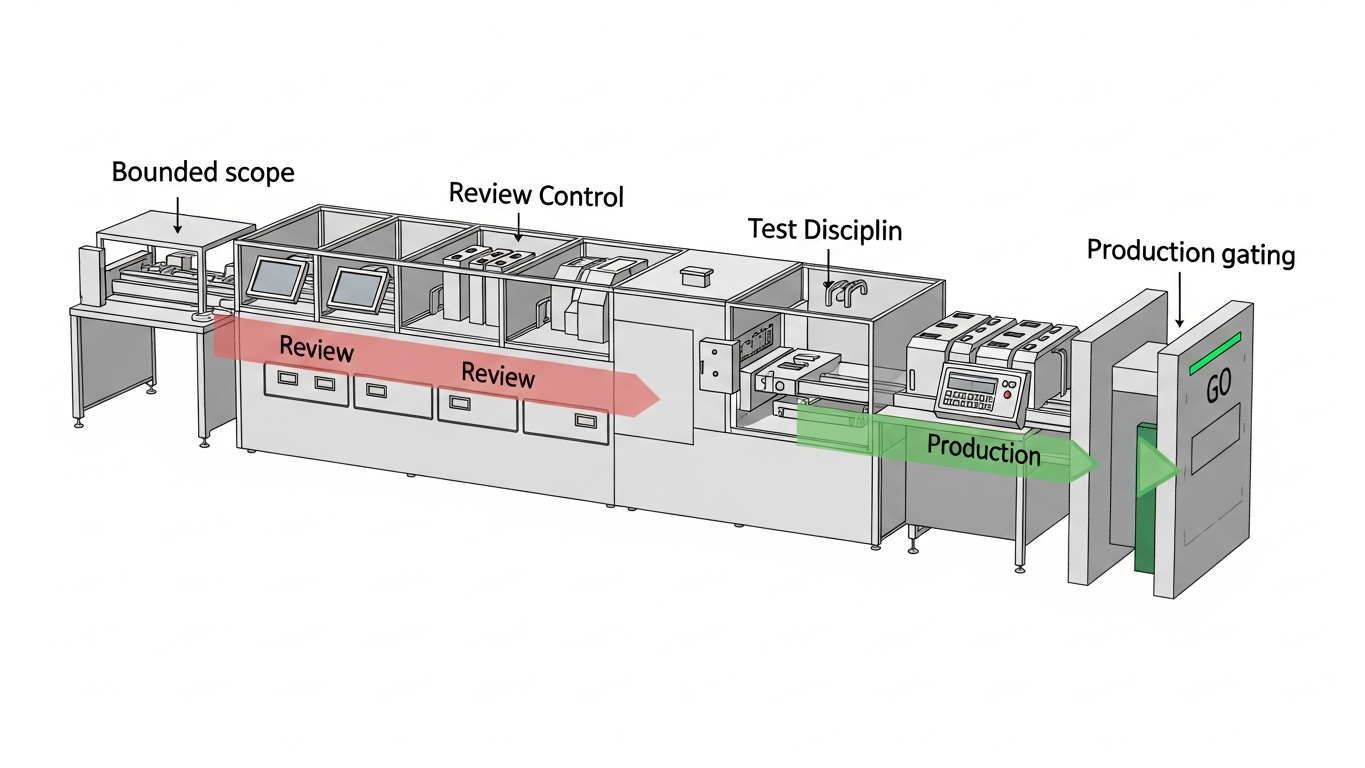
DBR77 Vector supports pilots that need explicit deployment boundaries and industrial reasoning without client-data training, reducing the gap between experimentation and legitimate scale-up. Book a demo or Review security.